Neonvoramila
Motion Library
Motion Library
Couldn't load pickup availability
- 📄 Digital file available after purchase
- 📚 Long-term availability
- 🔒 Secure checkout
- 📅 Content updated in 2026
Self-paced learning overview
1. Problem Statement
As digital content is created regularly, the collection of written materials, visual concepts, and editorial notes gradually expands. Without an organized storage system, locating relevant ideas, comparing earlier publications, and reusing prepared materials can become challenging. A single informational subject may require several presentation formats, yet the absence of adaptation guidelines can lead to unnecessary repetition or the loss of important details. Additional challenges appear when coordinating written messages, images, thematic series, and editorial calendars. Consequently, preparing new publications may involve repeated work and inconsistent material organization.
2. Solution
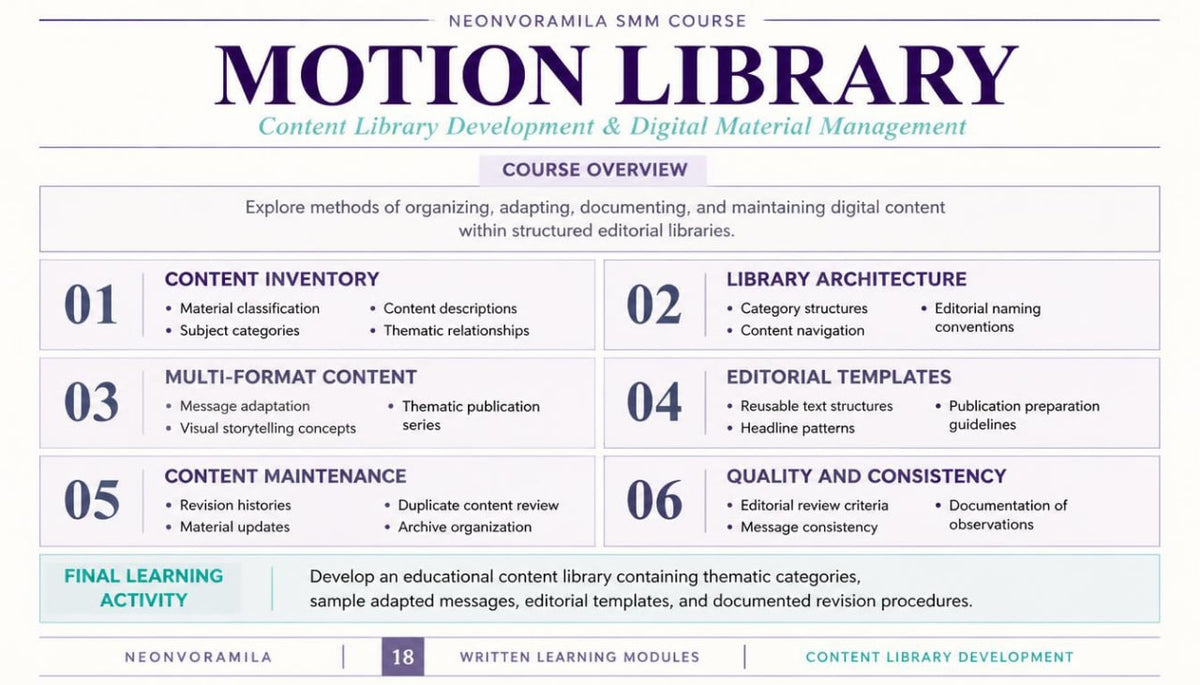
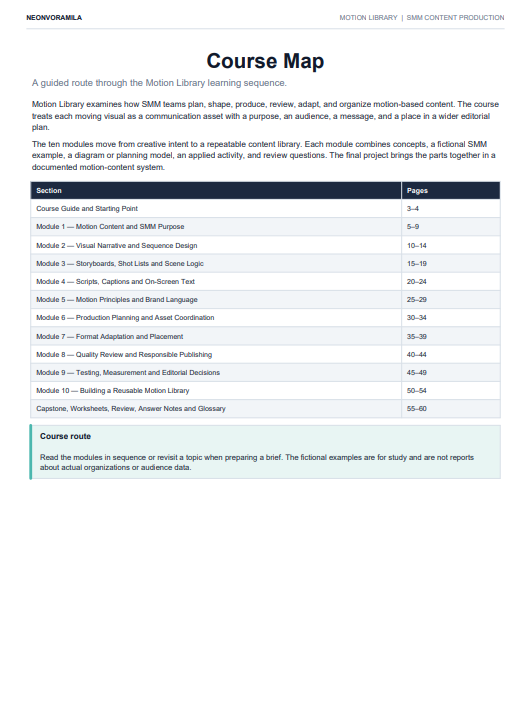
Motion Library introduces structured methods for developing and organizing content libraries for digital communication. The course explains how to classify materials by subject, format, purpose, and editorial preparation stage. Dedicated modules examine written message adaptation, visual storytelling sequences, and thematic content series developed from shared informational material. Practical exercises introduce change documentation, content consistency review, and the organization of reusable educational examples. The final assignment involves preparing an educational content library with defined categories, sample materials, and editorial guidelines.
3. What's Inside
Module 1: Content Library Fundamentals
Explore the purpose of content libraries and principles of organizing informational materials within digital communication.
Module 2: Content Inventory and Classification
Learn how to prepare a material inventory and classify content by subject, format, and informational purpose.
Module 3: Content Architecture and Navigation
Examine methods of creating logical category structures, subcategories, and thematic connections between materials.
Module 4: Editorial Material Templates
Study principles of developing reusable structures for headlines, informational sections, and short written messages.
Module 5: Multi-Format Content Planning
Learn how to plan the presentation of a single subject across several content formats according to its meaning.
Module 6: Visual Storytelling Frameworks
Examine visual storytelling principles involving a structured sequence of informational elements.
Module 7: Content Adaptation Methods
Learn how to adapt written materials to different lengths and structures while preserving their central message.
Module 8: Thematic Content Series
Explore methods of organizing publications into thematic series with shared subjects and logical informational sequences.
Module 9: Content Reuse and Reorganization
Study approaches to reusing existing materials through structural adjustments and changes in informational context.
Module 10: Editorial Naming Conventions
Examine how to establish understandable naming guidelines for materials, categories, and editorial versions.
Module 11: Content Version Management
Learn how to document changes in educational materials and distinguish earlier versions from revised editions.
Module 12: Visual and Written Content Coordination
Explore ways of coordinating headlines, written messages, and illustrative elements within a unified content concept.
Module 13: Publication Sequence Design
Study publication sequence planning while considering thematic relationships and message continuity.
Module 14: Editorial Quality Review
Examine criteria for reviewing clarity, factual accuracy, and consistency within educational content examples.
Module 15: Content Archive Maintenance
Learn how to review library structures, identify outdated materials, and organize editorial updates.
Module 16: Content Evaluation Notes
Explore methods of documenting observations about publication structure, format, and thematic relevance.
Module 17: Integrated Content Workflow
Examine the organization of connected stages involving content creation, editing, classification, and planning.
Module 18: Motion Library Content Studio
Prepare an educational content library containing thematic categories, adapted message examples, and an editorial documentation system.
4. Who Is This For?
✅ This course may suit you if you:
- Already understand foundational SMM principles, content strategy, and editorial planning.
- Want to learn how to organize extensive collections of thematic digital materials.
- Are interested in adapting one informational subject into several content formats.
- Would like to understand visual storytelling structures and thematic publication series.
- Want to organize written drafts, editorial notes, and publication materials.
- Are interested in maintaining content consistency during the editorial preparation process.
- Prefer written explanations, thematic frameworks, and practical learning exercises.
❌ This course may not match your needs if you:
- Are looking only for introductory explanations of digital communication.
- Need individually prepared or designed publications.
- Expect technical instructions for configuring advertising systems.
- Are searching for educational materials devoted entirely to statistical analysis of extensive datasets.
- Require personalized editorial guidance rather than independent study.
5. What You'll Learn
- Developing content library structures.
- Classifying digital materials.
- Creating editorial templates.
- Adapting messages across formats.
- Structuring visual stories.
- Planning thematic content series.
- Organizing content reuse.
- Documenting editorial revisions.
- Reviewing content consistency.
- Preparing an educational content archive.
6. Refund Terms
Refund requests for Motion Library may be submitted within 14 days of purchase. Request eligibility and applicable conditions for digital educational materials follow the store's published refund policy and applicable law.
7. Certificates & Credentials
Motion Library: Upon completing Motion Library, we will provide a Neonvoramila PDF certificate recognizing your study of motion content planning and organization.
1. What format do Neonvoramila courses follow?
1. What format do Neonvoramila courses follow?
Neonvoramila courses are presented as written educational materials organized into topics and modules. They contain explanations, subject-specific examples, and exercises for independent study. The contents of each course are described separately.
2. Do I need previous SMM experience?
2. Do I need previous SMM experience?
The Neonvoramila collection covers introductory and advanced digital communication topics. Early courses introduce foundational concepts, while later materials examine more detailed approaches to content planning, audience research, and communication analysis. We recommend reviewing the module descriptions before selecting a course.
3. How do the course tiers differ?
3. How do the course tiers differ?
Each tier focuses on a defined range of subjects and follows its own learning module structure. The courses are arranged from foundational concepts to more detailed SMM studies. The curriculum descriptions explain the topics covered in each set of educational materials.
Share